

You've got traffic. Your site looks good. Your content ranks. But something's missing.
Visitors land on your page, read your content, and then... nothing happens. They bounce. You lose the lead.
The issue usually isn't your traffic. It's your calls to action.
A weak CTA is invisible. A confusing CTA is a missed conversion. A poorly placed CTA is wasted real estate. Even with a beautiful website and high search rankings, your site won't achieve its full potential unless you convert visitors into leads or customers.
The fix is simpler than you think. It all comes down to the CTA.
Before you write a single word, understand what actually influences user behavior. Here's what works.
Color matters. Bright, contrasting colors make your CTA pop off the page. Red signals urgency. Blue builds trust. The key is contrast. Your CTA button needs to stand out from everything around it without looking like it doesn't belong.
Size has to be right. Make your CTA noticeable without overwhelming the page. It should be the obvious next step, not the only thing visible.
Placement drives action. This is the big one. CTA location determines conversion more than almost anything else. Above the fold (where users see it first). After compelling content (when they're most interested). Mid-page in long-form content (to catch readers at different engagement levels).
Design language speaks. Rounded buttons feel inviting and friendly. Sharp corners feel formal and corporate. Choose based on your brand and audience.

Words matter. A lot.
The difference between "Click Here" and "Claim Your Free Trial" isn't just better copywriting. It's the difference between a 2% conversion rate and a 5% conversion rate.
Here's how to write CTAs that actually work.
Use strong verbs. Action words create momentum. "Get." "Start." "Unlock." "Claim." These words tell people exactly what's about to happen, and they feel decisive.
Bad: "Learn More" Better: "Get Started Today"
Be specific and clear. Remove ambiguity. If someone has to wonder what happens when they click, they won't click. Tell them exactly what they'll get.
Bad: "Click Here" Better: "Claim Your Free Trial"
Create real urgency. Time-bound language works because it's true. If your offer is limited, say it. Don't fabricate urgency, but if you have a deadline, use it.
Bad: "Download Now" Better: "Download Now - Limited Time Offer"
Lead with benefits, not features. Nobody cares about your process. They care about what they'll gain. Reframe everything around the outcome.
Bad: "Sign Up for Our Newsletter" Better: "Get Exclusive Tips and Offers"
The shift from feature-focused to benefit-focused language is subtle, but the conversion lift is massive.
Theory is great. Data is better.
The only way to know what actually works for your audience is to test it. Here's what to test.
Test copy variations. "Get Started" vs. "Start Your Free Trial" vs. "Try It Now." You'll find one resonates more than the others. Run both versions simultaneously and measure which one converts higher.
Test color and placement. Different colors perform differently depending on your site design and audience. Same with placement. What works on a landing page might not work mid-blog post.
Track engagement metrics. Click-through rate. Conversion rate. Time to conversion. These numbers tell you exactly which versions win.
Run tests long enough to get statistical confidence. A few clicks aren't enough data. Run for at least a week, ideally longer.
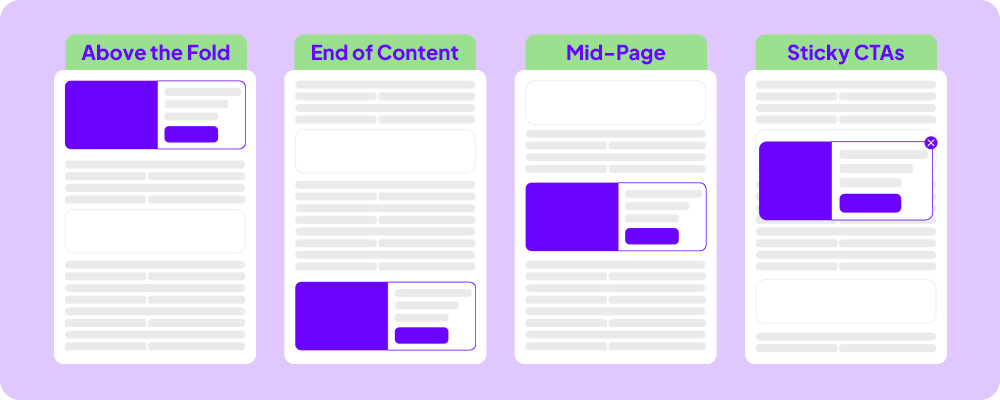
Location is destiny for CTAs.
Above the fold. First-time visitors need to see a CTA immediately. They're deciding whether to stay or leave. Give them a reason to engage right away.
End of content. After a compelling read, engagement is highest. This is when your reader is most convinced. Place a CTA here and capture motivated visitors.
Mid-page in long content. Not everyone reads to the end. Readers at different stages have different readiness levels. CTAs at 25%, 50%, and 75% down the page catch people where they are.
Sticky CTAs. Floating CTAs that stay visible as users scroll can be powerful if they're not intrusive. Use them sparingly and only if they add value rather than annoy.
The strategic approach: put CTAs where your audience is most ready to convert. Track which placements drive the highest conversion rates, then double down there.
Effective CTAs aren't random. They follow a pattern. Strong action verb. Clear outcome. Sense of urgency. Strategic placement. Benefit-focused language.
Implement these principles, test different versions, and watch your conversion rate climb. Most brands see 15-30% conversion increases just by refining their CTAs.
You don't need a complete website overhaul. You need better CTAs.
Let’s review your current creative, uncover what’s holding performance back, and build stronger CTAs with fully managed support.
No recruiting, no onboarding, no overhead. Just on-demand creative capacity that grows with your business and adapts to your needs.




.svg)